
Introduction
We live in a world where understanding the Scope of Digital Marketing has become the ultimate equalizer. A teenager in a small town can build a million-dollar brand using just a smartphone and an internet connection. A local bakery in Kerala can attract customers from across the country through a single viral Instagram reel. A startup with zero advertising budget can outrank a multinational on Google — simply by creating the right content. The scope of digital marketing is not limited by geography, budget, or background. It is limited only by your willingness to learn and take action.
This is the power of digital marketing.
Digital marketing refers to all marketing efforts that use the internet or electronic devices. Businesses leverage search engines, social media, email, websites, and mobile apps to connect with their current and potential customers. Unlike traditional marketing — which broadcasts a message to a wide audience and hopes for the best — digital marketing is targeted, measurable, and incredibly cost-effective.
The scope of digital marketing today is broader than ever before. As internet penetration deepens across India and the world, the scope of digital marketing is expanding at a pace that is genuinely hard to keep up with. From small businesses in tier 3 cities to global enterprises, everyone is waking up to the immense possibilities that digital channels offer. In this blog, we will break down exactly what the scope of digital marketing looks like in 2026 — the channels, the career paths, the industries, and the future trends shaping this field.
What Makes Digital Marketing Different?
Before diving into scope, it is worth understanding why digital marketing is fundamentally different from traditional marketing.
Claude responded: Every campaign gives you instant, clear insights into what is driving results and what needs to be improved — all as it happens.
Every campaign gives you instant, clear insights into what is driving results and what needs to be improved — all as it happens.
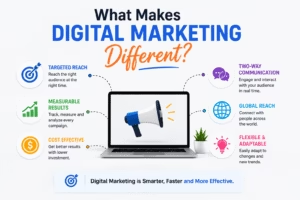
Targeting: Instead of showing an ad to everyone, digital marketing lets you show it only to a 25-year-old woman in Kozhikode who is interested in fitness and has visited your website before.
Cost efficiency: A small business can run a Facebook ad campaign for as little as ₹500 a day and reach thousands of potential customers.
Two-way communication: Unlike a TV ad, digital marketing allows brands to have real conversations with customers through comments, messages, and reviews.
Global reach with local focus: You can target someone in the next street or someone on the other side of the world — the choice is yours.
These advantages explain why businesses of all sizes are shifting their budgets from traditional channels to digital ones, and why the demand for skilled digital marketers keeps growing year after year.
The Core Channels of Digital Marketing
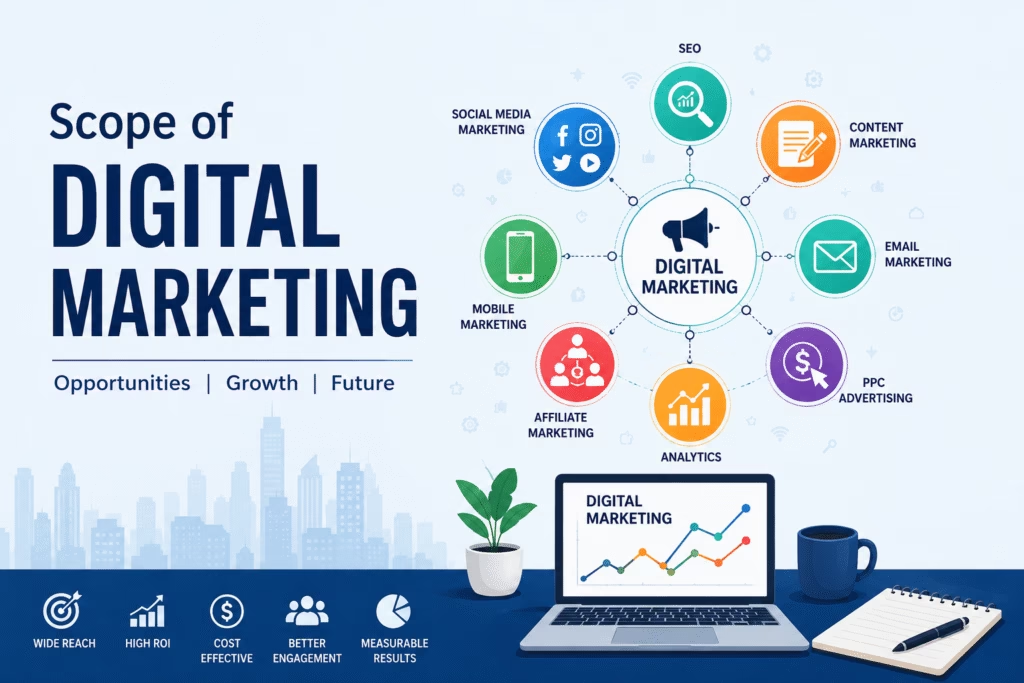
Digital marketing is not one single skill — it is a rich ecosystem of different disciplines. Each channel requires a unique set of skills, tools, and strategies.
Search Engine Optimization (SEO)

SEO is the art and science of getting your website to appear on the first page of Google without paying for ads. When someone searches for “best digital marketing course in Kerala,” SEO determines which websites show up first. It involves keyword research, on-page optimization, technical fixes, and building backlinks from other websites. Within the broader scope of digital marketing, SEO remains one of the most powerful and sustainable strategies a business can invest in.
- SEO is a long-term strategy but delivers compounding results over time — making it a cornerstone of the scope of digital marketing for businesses that want lasting online visibility.
- It is one of the most in-demand skills in the digital marketing world, and mastering it opens doors across every industry.
- SEO professionals are needed in every sector — from e-commerce to healthcare to education — proving just how wide the scope of digital marketing truly is when it comes to career opportunities.
Pay-Per-Click Advertising (PPC)
PPC involves running paid ads on platforms like Google Ads, YouTube, and Bing. Advertisers pay only when someone actually clicks on their ad — making it extremely efficient. A well-run Google Ads campaign can deliver immediate traffic and conversions, and within the scope of digital marketing, PPC stands out as one of the fastest ways to generate measurable business results.
- Google Ads is the most widely used PPC platform in the world, and its growing reach is a clear reflection of how vast the scope of digital marketing has become in the paid advertising space.
- Google Ads experts are in extremely high demand, making PPC one of the most lucrative career paths in the digital world today — a testament to the enormous scope of digital marketing when it comes to rewarding skilled professionals.
- Skills in data analysis and copywriting are essential for success in this field, as the scope of digital marketing through PPC requires both creative thinking and sharp analytical ability to consistently deliver strong results.
Social Media Marketing
With over 400 million social media users in India alone, platforms like Instagram, Facebook, LinkedIn, YouTube, and X (formerly Twitter) are goldmines for marketers. Social media marketing involves creating content, building communities, running paid campaigns, and engaging with audiences.
Instagram and YouTube are particularly powerful for brand building and influencer marketing.
When it comes to reaching business decision-makers and building professional relationships, LinkedIn stands out as the most powerful platform in the digital marketing landscape.
Short-form video content (Reels, Shorts, Stories) is currently the fastest-growing format.
Content Marketing
Content is the backbone of digital marketing. Blog posts, videos, infographics, podcasts, ebooks, and case studies — all of these are forms of content marketing. The goal is to attract, educate, and convert an audience by consistently providing value.
Consistently delivering valuable content helps brands earn the confidence of their audience and establish themselves as industry leaders.
It works hand-in-hand with SEO, social media, and email marketing.
Content marketers who can write, strategize, and analyze performance are highly valued.
Email Marketing
Despite being one of the oldest forms of digital marketing, email marketing continues to deliver the highest return on investment (ROI) of any channel — averaging ₹3,600 for every ₹100 spent. It involves building subscriber lists, crafting personalized email campaigns, and nurturing leads through automated sequences.
Email marketing is essential for e-commerce, SaaS companies, and any business with a customer base to retain.
Tools like Mailchimp, Klaviyo, and HubSpot make it accessible even for beginners.
Affiliate and Influencer Marketing
Brands pay content creators and website owners a commission to promote their products. This has exploded in India with the rise of Instagram influencers, YouTube creators, and niche bloggers. Influencer marketing alone is projected to be a ₹2,200 crore industry in India by 2025.
Micro-influencers (10,000–100,000 followers) often deliver better ROI than mega celebrities.
Affiliate marketing is one of the best ways for individuals to earn passive income online.
The Scope of Digital Marketing in India
India is one of the fastest-growing digital economies in the world, and the scope of digital marketing here is truly enormous.
India has over 860 million internet users — a number growing by millions every month.
The Indian digital advertising market isexpected to cross ₹50,000 crore by 2026.
Small and medium businesses (SMBs) across tier 2 and tier 3 cities are rapidly adopting digital marketing to grow their customer base.
The government’s push for Digital India has furtheraccelerated the adoption of online services across every sector.
Industries where digital marketing scope is particularly strong in India include:
E-commerce: Amazon, Flipkart, Myntra, and thousands of D2C brands need digital marketers constantly.
EdTech:Companies like BYJU’S, Unacademy, and Vedantu invest heavily in digital marketing to acquire students.
Healthcare: Hospitals, clinics, and health-tech startups are increasingly reaching patients through search and social media.
Real estate: Property portals and developers use SEO, PPC, and social ads to generate leads.
Travel and hospitality: Hotels, tour operators, and travel platforms run year-round digital campaigns.
Finance: Banks, insurance companies, and fintech startups use digital marketing extensively for customer acquisition.
Career Opportunities in Digital Marketing
One of the most exciting aspects of digital marketing’s scope is the sheer variety of career paths it offers. Here are some of the most in-demand roles:
SEO Specialist — Optimizes websites for search engines. Salary: ₹3L – ₹12L per year.
Social Media Manager — Manages brand presence across social platforms. Salary: ₹3L – ₹10L per year.
PPC / Google Ads Specialist — Runs and optimizes paid ad campaigns. Salary: ₹4L – ₹15L per year.
Content Strategist — Plans and oversees content creation across channels. Salary: ₹4L – ₹14L per year.
Email Marketing Manager — Builds and manages email campaigns and automations. Salary: ₹4L – ₹12L per year.
Digital Marketing Manager — Oversees the entire digital marketing strategy. Salary: ₹8L – ₹25L per year.
Analytics Specialist — Tracks performance and turns data into insights. Salary: ₹6L – ₹20L per year.
Freelance Digital Marketer — Works independently with multiple clients. Earning potential is unlimited.
Beyond jobs, digital marketing also enables entrepreneurship — you can start your own agency, launch a YouTube channel, run an affiliate blog, or build a personal brand that generates income.
Who Can Enter Digital Marketing?
This is one of the most accessible career fields in the world. You do not need a specific college degree or background. Digital marketing is open to everyone:
Fresh graduates from any stream — arts, science, commerce, or engineering.
Working professionals looking to upskill or switch careers.
Homemakers who want a flexible income from home.
Entrepreneurs who want to market their own businesses.
Students who want to start earning before graduation.
Content creators who want to monetize their audience.
What matters more than your degree is your curiosity, creativity, and willingness to learn. The tools are freely available, the courses are accessible, and the opportunities are everywhere.
How to Build a Career in Digital Marketing
Getting started is simpler than most people think. Here is a clear roadmap:
Step 1 — Learn the basics: Start with free courses from Google Digital Garage, HubSpot Academy, and Meta Blueprint. These give you a solid foundation and respected certifications.
Step 2 — Pick a specialization: Do not try to learn everything at once. Start with one channel — SEO, social media, or content marketing — and go deep.
Step 3 — Practice on real projects: Start a blog, manage a friend’s Instagram page, or volunteer for a local business. Real-world experience is more valuable than any certificate.
Step 4 — Build a portfolio: Document your results. Screenshots, analytics reports, and case studies are your best proof of skills.
Step 5 — Stay updated: Digital marketing changes constantly. Follow blogs like Neil Patel, Search Engine Journal, and Social Media Examiner to stay ahead.
Step 6 — Get your first client or job: Apply for internships, reach out to local businesses, or sign up on freelancing platforms like Fiverr and Upwork.
The Future of Digital Marketing
The scope of digital marketing is not just big today — it is only going to grow. Here are the key trends shaping its future:
Artificial Intelligence: AI tools like ChatGPT, Jasper, and Google’s AI ad systems are making campaigns smarter and faster. Marketers who can use AI effectively will have a massive advantage.
Video content dominance: Short-form video (Reels, Shorts, TikTok-style content) is the fastest-growing content format and will continue to dominate.
Voice search: With the rise of smart speakers and voice assistants, optimizing for voice search is becoming essential.
Hyper-personalization: Consumers expect brands to speak directly to their needs. Data-driven personalization will be the standard, not the exception.
Regional language marketing: In India especially, marketing in Malayalam, Tamil, Hindi, and other regional languages is a massive untapped opportunity.
Conclusion
Digital marketing is not a trend — it is the present and future of how businesses grow, connect, and compete. Its scope spans every industry, every city, and every level of experience. Whether you are a student looking for your first job, a professional wanting to pivot, or an entrepreneur ready to scale — digital marketing has a place for you.
The tools are free. The resources are abundant. The demand is real and growing. The only thing standing between you and a career in digital marketing is the decision to start.
Start today.
Auother;Shafi