

GEO vs SEO is becoming one of the most important topics in digital marketing today. As AI tools like ChatGPT and Google Gemini evolve, the way people search and find information is rapidly changing. Search as we knew it is changing — and changing fast. Tools like ChatGPT, Gemini, and Perplexity are answering questions that people used to type into Google.
Millions of users are getting direct, conversational answers without clicking a single link. And as this shift accelerates, a new optimization discipline has quietly emerged to help brands stay visible in this new landscape. That discipline is called GEO — Generative Engine Optimization. But before we dive into what GEO is and why it matters, let’s revisit the foundation it’s building on: SEO.
The Foundation: What Is SEO?
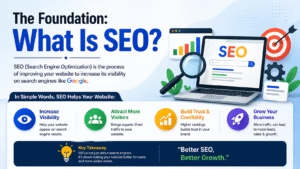
website traffic globally, making it the single most powerful force in digital marketing for the past two decades. At its core, SEO is the practice of making your website visible on search engines like Google and Bing — specifically, getting it to appear at or near the top of search results when people type in relevant queries.
Since the early 2000s, businesses of all sizes have invested heavily in SEO, recognizing that being found online is no longer optional — it’s survival. A local bakery, a global SaaS company, a personal finance blog — all of them compete in the same arena: the search results page.
SEO rests on three pillars. Technical SEO covers the behind-the-scenes work: site speed, mobile-friendliness, crawlability, and structured data. A site that loads slowly or isn’t optimized for mobile will be penalized by Google’s algorithm regardless of how great the content is. On-Page SEO focuses on your actual content — keyword research, meta titles, headers, image alt text, and making sure each page directly answers what searchers are looking for. Off-Page SEO is about authority — earning backlinks from reputable sites that signal to Google that your content is trustworthy and worth ranking.
The SEO game is essentially a negotiation with Google’s algorithm, which is updated hundreds of times a year. Get all three pillars right consistently, and your page climbs the Search Engine Results Page (SERP). Studies show the first organic result on Google captures around 27% of all clicks — which is why millions of businesses have poured enormous resources into SEO strategies, content calendars, and link-building campaigns.
For most of the internet age, this was the only game in town.More dramatic:
Google wasn’t just a search engine — it was the only door to the entire internet. End of story. But that story now has a new chapter.
Enter GEO — The New Frontier
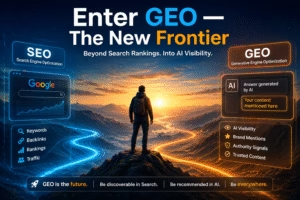
Generative Engine Optimization (GEO) is the practice of optimizing your content so that AI-powered tools — ChatGPT, Google Gemini, Claude, Perplexity, Microsoft Copilot — mention, recommend, or cite your brand when answering user questions. Understanding GEO vs SEO is no longer optional for marketers — it’s the new literacy of digital visibility.
The term is relatively new, but the behavior driving it has been growing rapidly since 2023. As large language models became publicly available and genuinely useful, a significant portion of internet users began turning to these tools not just for creative tasks, but for research, product recommendations, financial decisions, travel planning, and more. This is precisely where the GEO vs SEO conversation becomes critical — because the platforms people use to find information have fundamentally split.
Think about how behavior has shifted. A few years ago, if someone wanted to know which laptop to buy, they would Google it, scan several listicles, click through a few review pages, and eventually make a decision. Today, a growing number of people — especially younger, tech-savvy users — simply ask ChatGPT. They describe their needs in plain language, get a personalized recommendation in seconds, and act on it. No links clicked. No websites visited. No SERP engagement whatsoever. In the GEO vs SEO debate, this single behavioral shift explains everything.
If your brand isn’t mentioned in that AI-generated answer, you are completely invisible to that user — no matter how strong your Google ranking is, no matter how much you’ve invested in SEO. That’s not a hypothetical future scenario. It’s happening right now, across millions of daily interactions. Brands still fighting only the SEO battle are missing half the GEO vs SEO equation entirely.
That’s the gap GEO fills. It’s not about ranking on a results page — it’s about being the source an AI chooses to surface when it synthesizes an answer. In the world of GEO vs SEO, visibility now means being the brand an AI recommends, not just the link a user clicks.
Head to Head: GEO vs SEO
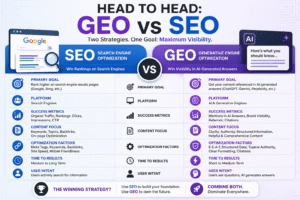
When comparing GEO vs SEO, the differences go far deeper than just the platform. Here’s a complete breakdown of how GEO vs SEO stacks up across every major dimension:
Target platform — SEO: Google, Bing, Yahoo | GEO: ChatGPT, Gemini, Claude, Perplexity Goal — SEO: Rank high on SERP | GEO: Be cited in AI-generated answers Key signals — SEO: Backlinks, keywords, page speed | GEO: Authority, clarity, structured data Output — SEO: A ranked link the user clicks | GEO: Brand mention in an AI response Success metric — SEO: Organic traffic, click-through rate | GEO: AI citation frequency, brand visibility Content style — SEO: Keyword-rich, long-form articles | GEO: Question-answering, factual, well-structured Measurement tools — SEO: Google Search Console, Ahrefs, SEMrush | GEO: Brand monitoring, AI prompt testing
The GEO vs SEO comparison above makes one thing clear — these are two distinct disciplines built for two different eras of search. While traditional SEO optimizes for algorithms that rank pages, GEO vs SEO thinking reveals that generative optimization is about earning trust from AI systems that synthesize answers. Knowing where your brand stands in the Generative Engine Optimization vs Search Engine Optimization landscape is the first step toward building a strategy that works in both worlds.
How GEO Actually Works
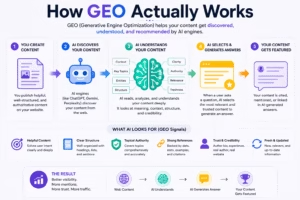
AI models don’t index the web the same way Google does. They’re trained on vast datasets of text from across the internet, and the most capable ones also pull live information through real-time web browsing. This means two things: the content that shaped their training matters, and fresh, credible content they can access today also matters.
To be cited by an AI, your content needs to be genuinely authoritative, clearly structured, factually accurate, and easy for a language model to understand and excerpt.Direct & confident:
These are the five moves that separate GEO-ready brands from everyone else:
- Write for questions, not just keywords. GEO-friendly content directly and completely answers specific, natural-language questions. Instead of targeting “best CRM software” as a keyword, think about questions like “What is the best CRM software for small businesses with remote teams?” Write content that answers those questions thoroughly, in plain language, without burying the answer. AI tools are far more likely to cite a source that gives a clear, direct answer than one that makes the reader hunt for it.
- Build topical authority. AI tools strongly favor sources that demonstrate deep expertise in a specific area. A website that comprehensively and consistently covers one subject — going beyond surface-level overviews totackle nuanced subtopics — is far more likely to be cited than a generalist site withshallow content spread across dozens of unrelated topics. Think of it as becoming the go-to encyclopedia for your niche.
- Use structured, scannable formatting. Clear headings, bullet points, numbered lists, concise definitions, comparison tables, and FAQ sections all make it significantly easier for an AI to extract and present your information accurately. Schema markup — a form of structured data added to your website’s HTML — helps machines understand the context and meaning of your content, making it more likely to be interpreted correctly and cited appropriately.
- Earn citations and mentions across the web. When reputable, high-authority sites reference your brand, quote your experts, or link to your research, AI models pick up on those signals during training and when browsing the web. PR campaigns, thought leadership articles in industry publications, podcast appearances, and expert quotes in news stories all contribute to the kind of third-party validation that makes an AI more likely to treat your brand as a credible source worth recommending.
- Maintain accuracy and freshness. AI tools that browse the web in real time reward content that is factually accurate, regularly updated, and supported by verifiable data points — statistics, dates, named studies, and cited sources. Outdated or factually shaky content not only risks being ignored; it risks being actively contradicted by the AI, which can damage trust in your brand.
Do You Have to Choose?
Here’s the reassuring news: SEO and GEO are not competing strategies — they are complementary ones. High-quality, well-structured content that genuinely satisfies a human reader tends to perform well on both traditional search engines and AI-powered answer tools. The core fundamentals of good content — authority, clarity, relevance, accuracy, and trustworthiness — matter in both worlds.
The difference is one of emphasis and intent. SEO rewards content that is optimized around keyword density, meta data, and backlink profiles. GEO rewards content that is optimized to directly and comprehensively answer questions in a way that a language model can easily understand, excerpt, and present with confidence. Brands that learn to master both approaches simultaneously will have a decisive competitive advantage as search behavior continues to fragment across an ever-growing range of platforms and tools.
Think of it this way: SEO gets you found by people who are actively searching. GEO gets you recommended to people who are asking. Both matter. Neither is going away.
The Bigger Picture: Why This Shift Matters
Google remains the world’s dominant search engine by a wide margin — but its share of the “question-answering” market is no longer 100%. Younger demographics in particular are increasingly turning to AI tools for research, product recommendations, travel planning, financial decisions, and more.
A 2024 survey found that a significant percentage of Gen Z users prefer asking AI assistants over using traditional search for many types of queries. This is exactly why the GEO vs SEO conversation has moved from niche marketing circles to boardroom strategy sessions almost overnight.
This isn’t a future trend being projected on a distant horizon. It’s happening now, in real time, across millions of daily user interactions. Every day that a brand ignores the GEO vs SEO divide is a day it hands visibility to competitors who are already adapting.
Brands that continue to optimize exclusively for Google are already leaving meaningful visibility on the table. At the same time, those who abandon proven SEO practices in favor of chasing AI citations are making an equally costly mistake — billions of searches still happen on traditional engines every single day, and that traffic is too valuable to walk away from.
The GEO vs SEO debate was never meant to be an either-or choice. The smart play is an integrated, dual-track content strategy: one that produces genuinely useful, deeply authoritative content, formatted and structured to perform well in both environments simultaneously. That is the real answer to the GEO vs SEO question — not picking a side, but mastering both.
Conclusion
SEO wrote the digital marketing rulebook for the last two decades. GEO is writing the next one — and that transition is already underway. The GEO vs SEO shift isn’t a disruption to fear — it’s an opportunity to seize. The fundamental goal hasn’t changed: reach your audience at the exact moment they need you. What has changed is where that moment happens and how many platforms it happens on.
Start by auditing your existing content through the lens of GEO vs SEO. Does it answer real, specific questions clearly and directly? Is it structured in a way that both humans and machines can easily understand and excerpt? Is your brand being mentioned and cited by credible, authoritative sources across the web? If the answer to any of these is no, you already have your GEO vs SEO roadmap — and now you know exactly where to start.
Don’t abandon your SEO foundation — extend it, adapt it, and build GEO on top of it. The brands that win the GEO vs SEO race won’t be the ones who picked a side. They’ll be the ones who mastered both. The future of search belongs to brands that show up everywhere people look for answers — on Google, in ChatGPT, through Gemini, and on whatever platform comes next.
Author;shafi