
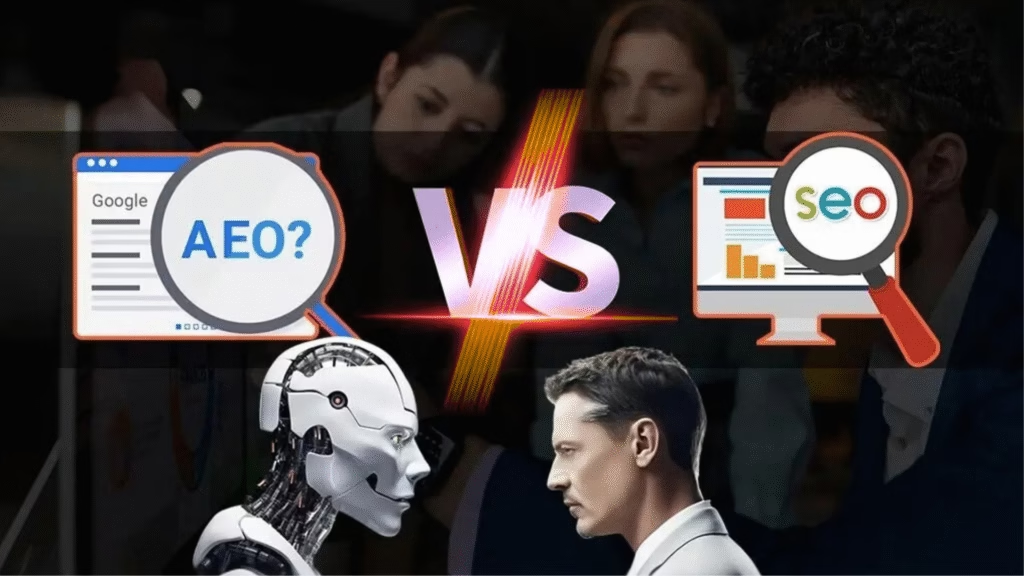
AEO vs SEO digital marketing is becoming one of the most important topics in modern search strategy.Search is changing — and if you’re still only thinking about SEO, you may already be falling behind. A new strategy called Answer Engine Optimization (AEO) is reshaping how brands get discovered online. But does it replace SEO, or does it work alongside it?
In this post, we’ll break down the differences between AEO and SEO, explain why AEO is gaining momentum, and help you figure out exactly where to focus your digital marketing efforts in 2025 and beyond.
What Is SEO (Search Engine Optimization)

Search Engine Optimization, or SEO, is the practice of optimizing your website and content so that it ranks higher in traditional search engine results pages (SERPs) — primarily on Google, Bing, and similar platforms.
When someone types a query into Google, the search engine crawls and indexes millions of web pages, then ranks them based on hundreds of factors: relevance, authority, page speed, backlinks, keyword usage, user experience, and more. SEO is the art and science of making sure your content ticks as many of those boxes as possible.
SEO has shaped digital marketing strategy for more than twenty years. It encompasses a wide range of tactics, including on-page optimization (crafting titles, meta descriptions, headers, and content around target keywords), off-page optimization (earning backlinks from reputable websites), and technical SEO (improving site structure, crawlability, and performance). Done well, SEO drives consistent, long-term organic traffic to your website.
The goal of SEO is simple: get your page onto the first page of search results, ideally in one of the top three positions, where the vast majority of clicks happen.
What Is AEO (Answer Engine Optimization) in AEO vs SEO Digital Marketing?
In the evolving landscape of AEO vs SEO digital marketing, Answer Engine Optimization (AEO) is a newer discipline focused on optimizing your content so that AI-powered answer engines and voice assistants can extract and deliver direct answers to users’ questions without necessarily sending them to your website.
Voice assistants like Siri, Google Assistant, and Alexa have become part of our daily routines. Think about the last time you typed a query into Google and received a featured snippet with the answer displayed at the top of the page. Within the broader shift of AEO vs SEO digital marketing, this is the growing influence of answer engines. With the explosive rise of AI chatbots and AI-generated search experiences, answer engines are now handling a significant share of everyday search behavior.
AEO in AEO vs SEO digital marketing is about structuring your content so that these systems can understand it, trust it, and use it as a reliable source. This involves creating content that directly answers specific questions, using structured data markup (like Schema.org), writing in a clear and concise way that’s easy for AI to parse, and building strong topical authority.
Unlike traditional SEO, which ultimately aims to drive clicks to your site, AEO represents a major shift in AEO vs SEO digital marketing — it is about becoming the answer itself, even if the user never visits your page.
AEO vs SEO Digital Marketing: The Key Differences
In the world of AEO vs SEO digital marketing, both strategies share the same underlying goal — getting your content in front of the right audience. However, they differ significantly in approach, intent, and measurement.
Intent and outcome represent the most fundamental difference in AEO vs SEO digital marketing. SEO aims to rank your page in search results, driving traffic to your website. AEO, on the other hand, aims to get your content used as a direct answer, which may or may not result in a click. In an AEO context, being “found” can mean your brand is mentioned in an AI-generated response, even if no one ever sees your URL.
Keyword strategy also diverges in AEO vs SEO digital marketing. SEO traditionally focuses on keywords and search volume — identifying the phrases people type into search engines and optimizing for them. AEO prioritizes questions and conversational phrases. Because voice search and AI tools often receive full questions rather than short keywords (“What’s the best way to remove a grass stain?” rather than “remove grass stain tips”), AEO content is structured around natural language and question formats.
Content structure differs as well within AEO vs SEO digital marketing strategies. SEO content is often written to satisfy both users and search engine crawlers — it needs to be engaging, authoritative, and keyword-rich. AEO content tends to be more concise and direct in places, with clear question-and-answer formatting, short paragraphs, and structured data markup that helps AI systems extract precise information.
Measurement looks different too in AEO vs SEO digital marketing. SEO success is typically measured through rankings, organic traffic, and click-through rates. AEO is harder to measure because being cited in an AI overview or voice response often leaves no trackable click behind. Brand mentions, share of voice in AI-generated responses, and visibility in featured snippets become increasingly important metrics.
Why AEO Is Becoming More Important in AEO vs SEO Digital Marketing
AEO isn’t chasing a trend — it’s adapting to a deeper change in how people find information. In today’s AEO vs SEO digital marketing landscape, businesses must understand how AI-driven search is reshaping online visibility.
According to various industry studies, a significant and growing share of Google searches now result in zero clicks, meaning the user gets their answer directly from the search results page without ever visiting a website. In the context of AEO vs SEO digital marketing, this shift highlights why answer optimization is becoming essential. Google’s AI Overviews, which now appear for a wide range of queries, have accelerated this shift dramatically.
For businesses and content creators, this creates both a challenge and an opportunity within AEO vs SEO digital marketing strategies. The challenge is that traditional SEO traffic may continue to erode as more answers are delivered directly in search results. The opportunity is that brands which optimize for AEO can earn a prominent place in AI-generated responses, gaining visibility and trust even in a zero-click environment.
AEO also rewards depth and authority. AI systems are built to pull from sources that are comprehensive, well-structured, and credible. Building out thorough, expert-level content is now a core part of AEO vs SEO digital marketing, and it also strengthens long-term SEO performance.
How to Optimize for AEO
If you want to start capturing answer engine traffic, here are the most important tactics to focus on.
Create question-based content. Build blog posts, FAQ pages, and guides around the specific questions your audience is asking. Tools like Google’s “People Also Ask” feature, AnswerThePublic, and Reddit forums are goldmines for finding real questions people need answered.
Use structured data markup. Schema.org provides a vocabulary for marking up content so that search engines and AI systems can understand it more precisely. FAQ schema, HowTo schema, and Article schema are especially valuable for AEO purposes.
Write in a clear, direct style. When answering a question, lead with the answer — don’t bury it three paragraphs in. AI systems scan for the most direct, accurate answer to a query, so structuring your content with that in mind will increase your chances of being selected.
Build topical authority. Don’t just write one article on a subject — build out a comprehensive library of content around your core topics. Topical clusters signal expertise to both traditional search engines and AI systems.
Earn credibility signals. AI tools tend to favor sources that are trustworthy, well-cited, and linked to from other reputable sites. This ties back to traditional SEO: backlinks, author credentials, and E-E-A-T (Experience, Expertise, Authoritativeness, Trustworthiness) signals matter enormously for AEO.
Do You Still Need SEO?
Absolutely — SEO is not dead. Far from it.
The majority of people still use traditional search engines for a wide range of queries, and organic search remains one of the highest-converting sources of website traffic available. Businesses that abandon SEO in favor of AEO alone will likely see their overall visibility decline.
What’s changing is that SEO is no longer sufficient on its own. The two strategies are increasingly complementary. Strong SEO practices — building authority, earning quality backlinks, creating well-structured content — form the foundation that AEO sits on. And many AEO tactics, like question-based content and structured data, actively improve your SEO performance as well.
Think of it this way: SEO gets people to your website; AEO gets your content into the conversation, whether or not your website is the destination. Both matter, and the smartest brands are pursuing both simultaneously.
Conclusion
The digital search landscape is evolving faster than at any point in the past decade. AEO is not a replacement for SEO — it’s an evolution of it, driven by the emergence of AI-powered tools that are changing the way people find and consume information.
Brands that understand this shift and adapt their content strategies accordingly will be far better positioned for what comes next. Those that treat SEO and AEO as competing strategies will miss out on the full picture.
The most powerful approach is to build content that’s genuinely useful, clearly structured, and deeply authoritative — content that earns top rankings in traditional search and gets cited by AI answer engines alike. In 2025 and beyond, that’s what winning at search looks like.
author: shafi